Wednesday, April 22, 2009

Hailer TV

The Hailer is back with another blast, and this time, it's randomer. Introducing the first episode of Hailer TV. Check it out:


Join the Hailer!

For further inquiries, contact the Hailer at: thehailer.magazine@gmail.com or you can come to the desk at the office and collect a copy of the Membership Application Form.

Tuesday, February 17, 2009

Feedback for Student Council

Having served you for a year, we would like to hear your opinions about the Student Council. We would like to know how we can improve the Council to better serve you, and what we should implement to make your stay in the College more comfortable. Of course, all suggestions will be considered. =)

So yes, what feedback do you have? =) Do comment!

Thursday, February 5, 2009

Study Smart

Building an Understanding

Learning is a process similar to building a house. You aren’t fed the complete picture. Limitations on communication prevent the instantaneous transmission of knowledge. Instead you listen to lectures, read textbooks and take painstaking notes to try and comprehend a subject.

You are fed building supplies, bricks, mortar and glass. It is up to you to assemble the building. Unfortunately, most learning strategies fall into two basic types:

  1. Memorization - Instead of building anything you simply stare at each brick for several minutes trying to record its position.
  2. Formulas - This is the equivalent to being blind, fumbling around a new house. You can’t see the building itself but you learn to come up with simple rules to avoid walking into walls.

There is nothing particularly wrong with either of these strategies, assuming they aren’t your entire strategy. The human brain isn’t a computer so it can’t memorize infinite sums of knowledge without some form of structure. And formulas no longer work if the questions they are designed to solve change scope.

Learning Holistically

The alternative strategy is to focus on actually using the information you have to build something. This involves linking concepts together and compressing information so it fits in the bigger picture. Here are some ideas to get started:

  1. Metaphor - Metaphors can allow you to quickly organize information by comparing a complex idea to a simple one. When you find relationships between information, come up with analogies to increase your understanding. Compare neurons with waves on a string. Make metaphors comparing parts of a brain with sections of your computer.
  2. Use All Your Senses - Abstract ideas are difficult to memorize because they are far removed from our senses. Shift them closer by coming up with vivid pictures, feelings and images that relate information together. When I learned how to do a determinant of a matrix, I remembered the pattern by visualizing my hands moving through the numbers, one adding and one subtracting.
  3. Teach It - Find someone who doesn’t understand the topic and teach it to them. This exercise forces you to organize. Spending five minutes explaining a concept can save you an hour of combined studying for the same effect.
  4. Leave No Islands - When you read through a textbook, every piece of information should connect with something else you have learned. Fast learners do this automatically, but if you leave islands of information, you won’t be able to reach them during a test.
  5. Test Your Mobility - A good way to know you haven’t linked enough is that you can’t move between concepts. Open up a word document and start explaining the subject you are working with. If you can’t jump between sections, referencing one idea to help explain another, you won’t be able to think through the connections during a test.
  6. Find Patterns - Look for patterns in information. Information becomes easier to organize if you can identify broader patterns that are similar across different topics. The way a neuron fires has similarities to “if” statements in programming languages.
  7. Build a Large Foundation - Reading lots and having a general understanding of many topics gives you a lot more flexibility in finding patterns and metaphors in new topics. The more you already know, the easier it is to learn.
  8. Don’t Force - I don’t spend much time studying before exams. Forcing information during the last few days is incredibly inefficient. Instead try to slowly interlink ideas as they come to you so studying becomes a quick recap rather than a first attempt at learning.
  9. Build Models - Models are simple concepts that aren’t true by themselves, but are useful for describing abstract ideas. Crystallizing one particular mental image or experience can create a model you can reference when trying to understand. When I was trying to tackle the concept of subspaces, I visualized a blue background with a red plane going through it. This isn’t an entirely accurate representation of what a subspace is, but it created a workable image for future ideas.
  10. Learning is in Your Head - Having beautiful notes and a perfectly highlighted textbook doesn’t matter if you don’t understand the information in it. Your only goal is to understand the information so it will stick with you for assignments, tests and life. Don’t be afraid to get messy when scrawling out ideas on paper and connecting them in your head. Use notes and books as a medium for learning rather than an end result.

In addition, these are some tips you might want to consider:
  • Be good to yourself.
    • Keep physically fit and rested.
  • Attitude is all-important.
    • Use positive affirmations: "I can pass American History."
    • Provide your own psychological edge, be it a positive attitude or a "lucky pen."
  • Be a chronic enthusiast!
  • Used textbooks may provide insights on a course.
  • Sit in the front row;
    • if you must sit toward the back of the room, lean forward.
    • Attentiveness and concentration increase markedly.
  • Don't miss the first and last minutes of class.
    • They are crucial — important announcements, questions on test, etc.
  • Use a variety of study techniques.
    • a. Tape chapters (find out if your textbook has companion pod cast chapters). Listen on way to school, work.
    • b. Use index cards for quick review.
    • Keep them simple. Throw your highlighter away!
    • Remember: frequent review takes facts from short-term memory to long-term memory — learning as opposed to cramming.
  • Study in short bursts.
    • (First and last facts are remembered best; therefore, it will accelerate learning.)
  • Review notes immediately after class.
    • Even for five minutes.
    • Something magical happens!
  • Review your notes out loud.
    • Read your chapters out loud.
  • Appearance raises grades.
    • Neatness counts.
    • Word processors are a plus.
    • If a handwritte assignment is acceptable, use erasable pen.
  • Don't waste time rereading.
    • Rely on "pen in hand" and SQ3R.
  • Test professors before they test you.
    • Ask questions about what kind of test to expect,
    • what material will be covered.
  • Become an expert test taker.
  • Go with initial hunches.
  • Stay with initial hunches.
  • Study according to your biological clock.
    • Are you "normal," a night owl, or an early bird?
  • Eliminate stress in your life.
  • EXERCISE is the best antidote.
  • Make extra credit mandatory.
  • Never miss a class.
    • This is considered mandatory by "A" students.
  • Be prepared to bail out.
    • Don't be afraid to drop a course that is not working for you., BUT be aware of all official dates to withdraw and any vital state legislative restrictions ( Texas has a limit on total number of W hours.)
  • Volunteer to edit a friend's paper.
    • Use it as a learning experience.
  • Study smart—not hard!
  • Time management skills and discipline pay off.
  • Stay mentally, physically and spiritually fit.

All the best to your studies! =)

Thursday, December 18, 2008

Howdy Upcoming Christmas


You Life College people! 

Merry Merry Christmas! =) 

We hope that you would spend this upcoming Christmas with the widest smiles you had worn this year and savor each and every moment of them. 

A tip to enjoying your Christmas to the max: Forget about but learn from the mistakes you've done this year and look forward. Step away from self-condemnation and towards self-encouragement. Mistakes will take on a brighter color if we learn from it instead of dwelling in our pasts and condeming ourselves for what we've done. 

Life is more than yesterdays; life is what is to come. Let's enjoy. =)

Sunday, December 14, 2008

It's A Beginning

A blast would be how I, personally, would describe the Year End Bash to be. 

I am sure many of you who went would think so too. 

After all, it was our first ever Life College event. Although it isn't as grand as many college's prom night... with grand lights and effects, awesome video and so forth... yet, it has to start somewhere, agreed? 

This is just the beginning, friends, of improvement. We hope next year, there can be another function again - depending, of course, on the Student Council during that time. So, pray hard, if you want to have another event. 

Also, we would LOVE to hear your personal comments - good or bad, whatever they be. Just be thoroughly honest; we love honesty. 

We want to improve, for the students' sake. So, yes, do drop me (jonnychu89@gmail.com) or any council member an email, stating what you thought about the event and if possible, how we could improve or what we should look into in the future. 

We thank you in advance for the comments you are to give. =)

It has been a privilege serving you people for year 2008. Help us to help you; drop a comment! =)

Monday, December 8, 2008

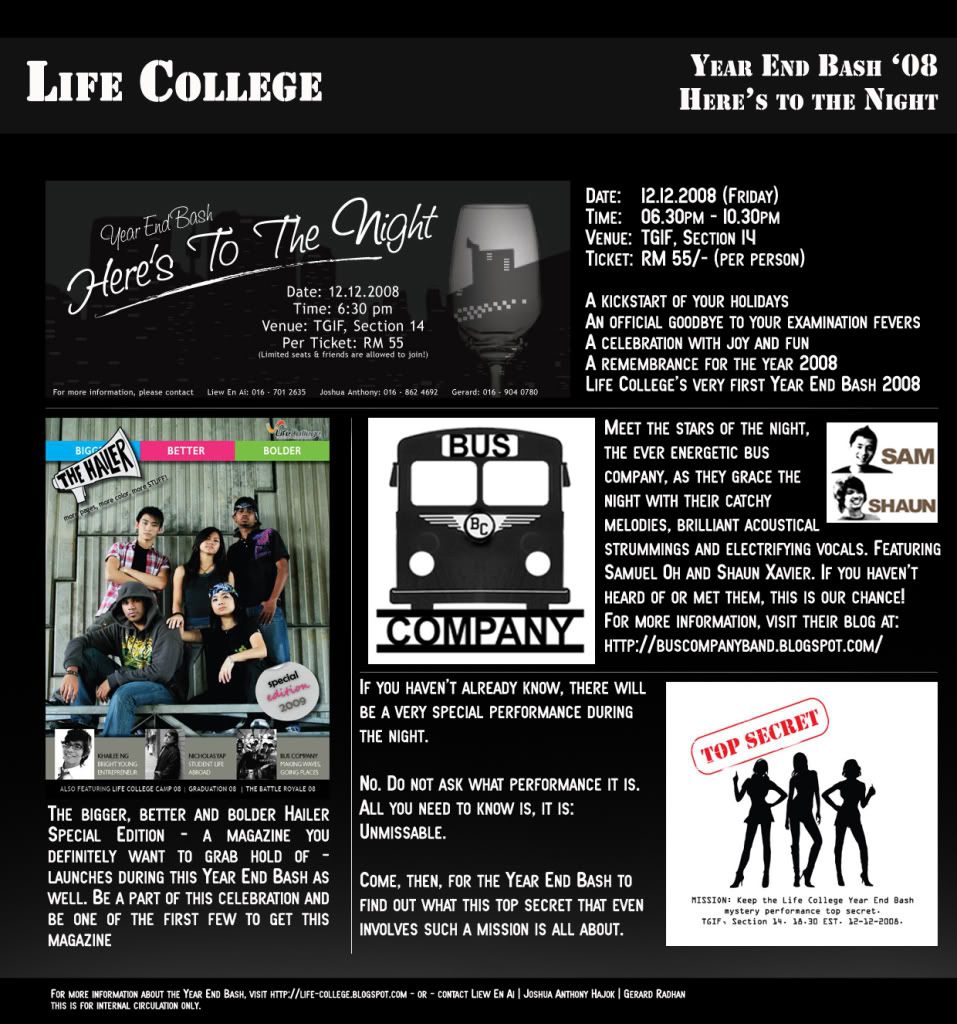
The Year End Bash in a Whole


Click for larger view

Collect Your Tickets!

If you have not collected your tickets, do quickly do so! 

It's like a ticket for your entry! =)